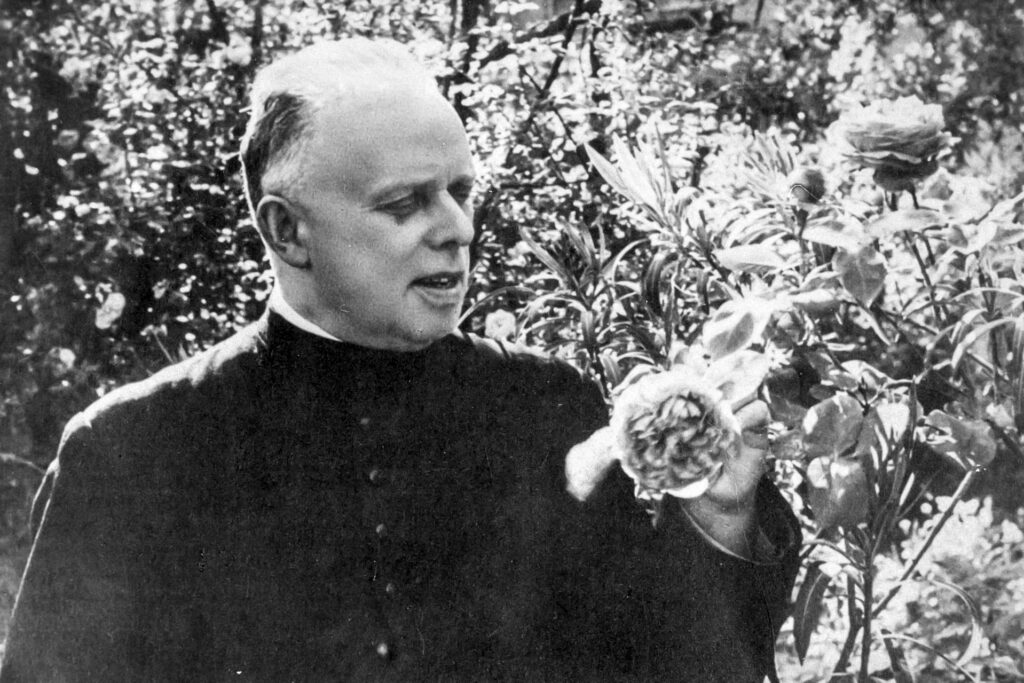
Biografia | Biography |
|
|
|
Page 1 of 3 Peasant OriginsPrimo Mazzolari, the son of Luigi and Grazia Bolli, was born on January 13, 1890 in Boschetto, a small village in the province of Cremona in Northern Italy. His father supported the family as a small tenant fieldworker. Primo, the firstborn, was followed by Colombina, Giuseppe (Peppino), Pierina, and Giuseppina. In 1900 the Mazzolari family moved to Verolanuova, in the province and diocese of Brescia, in order to find better work and living conditions. After completing elementary school two years later, Primo decided to enter the seminary. He attended the seminary in Cremona, where Bishop Geremia Bonomelli was celebrated for his Catholic-liberal ideas that conciliated with the young Italian State. Life in the Seminary Primo Mazzolari attended the Cremonese institute until 1912, when he was ordained priest. For the occasion, he returned to his family in Verolanuova, where he received the holy orders in the parish church from the Bishop of Brescia, Monsignor Gaggia. The following decade in Cremona proved very difficult for the young seminarian. These were severely repressive years of anti-modernism, launched by Pius X. This situation resulted in more rigid discipline in the seminaries, the dismissal of professors deemed too innovative, and the end of any dialogue with contemporary culture. Mazzolari had to confront a series of vocational crises that he overcame with the enlightened help of the Barnabite priest, Pietro Gazzola, who had previously left Milan precisely because he was suspected of indulgence toward modernism. Father Gazzola predicted to the young Mazzolari that his adult life would be "a cross to bear." Firsts Appointments Once a priest, don Primo appointed vicar in Spinadesco (Cremona). The following year he transferred to his childhood parish church, Santa Maria del Boschetto. Soon after, in the fall of 1913, he was selected as a humanities teacher in the seminary grammar school. He assumed this role for two years and spent summer vacations with Italian emigrant workers in Arbond, Switzerland as a chaplan for the Bonomelli missions, similar in spirit and purpose to the more famous missions and religious order establishd by Bishop Scalabrini of Piacenza (a neighboring diocese).. Meanwhile, the First World War broke out and in the spring of 1915, vehement conflicts arose regarding Italy's position in the war. don Mazzolari sympathized with the predicament of the democratic interventionists, as did other young Catholics, such as Eligio Cacciaguerra, the organizer of the Democratic Christian League and of the Azione newspaper from Cesena, to which Mazzolari contributed various articles. Primo decided to support Italian military intervention in order to eliminate the kind of militarism that was symbolized by Germany, to help establish a new democratic regime, and to facilitate international collaboration throughout Europe. The Trials of War The war immediately caused the young priest deep grief. In fact, his beloved brother, Peppino, who was killed in the battle of Sabotino in November 1915, always remained vivid in don Primo's memory. He had, in any case, already decided to volunteer. He entered the Medical Corps and worked at hospitals in Genoa and then in Cremona. Concerned about feeling like a draft-dodger, don Mazzolari asked to be transferred to the front. In 1918, he became a military chaplain and followed the Italian troops to the French front. He remained in France for nine months. In 1919 he returned to Italy where he carried out other assignments for the Royal Army, including recovering the corpses of fallen soldiers along the North East front line. In 1920 he spent six months in Upper Slesia with Italian troops that were sent to maintain order in this region that, had been forced to cede from Germany and became part of the newly reconstructed Poland. All testimonial accounts point to the commitment and human passion with which don Primo supported the soldiers during this difficult time. The Cicognara Period After being discharged in August 1920, don Mazzolari asked his bishop, Monsignor Giovanni Cazzani, if, instead of teaching in the seminary, he could be assigned to pastoral work among the people. From October 1920 to December 1921, he was pastor of the parish church of the Most Holy Trinity in Bozzolo, a town in the province of Mantova, yet dependent on the diocese of Cremona. From here he was transferred as a pastor in the village of Cicognara, a short distance from the Po River, where he lived for a decade, until July 1932. In Cicognara, don Primo gained experience as a parish priest, experimented with initiatives, reflecting upon and interpreted ideas, and-above all-searched for new ways to attract those who had turned away from the Church. The town, in fact, had a strong socialist undercurrent. In various ways, don Mazzolari appreciated popular peasant traditions, such as the grain and grape harvest festivals. He also commemorated those killed in the war, engaged in patriotic celebrations, created a parish library and, held a night school for peasants in winter. He distrusted and was troubled by Fascism since its onset, and did not hide his intense opposition. Already in 1922, he wrote about those Catholics who were sympathetic toward the growing regime, "As paganism returns and brushes against us, few feel embarrassed." In November 1923 he refused to sing solemnly the Te Deum after an attempt on Mussolini's life was thwarted. In 1929, in contrast to many enthusiastic bishops and priests, he did not vote in the plebiscite that Mussolini ordered after the signing of the Lateran Pacts, the international treaty that put an end to the opposition of the Vatican to the unification of Italy and granted political rights and privileges to the Church. Meanwhile, he refused any non-discerning exaltation of the war and militarism, and rejected all sectarian or partisan sentiments. Even though he avoided openly taking a position of opposition, don Primo was soon considered an enemy in the eyes of the Fascists and an obstacle to the Fascist efforts in Cicognara. On the night of August 1, 1931 he was called to his window and shot at three times by a pistol. But fortunately, the bullets did not hit him. |
|||||
| Home |
| Biografia |
| Opere |
| Bibliografia |
| Novità Librarie |
| Antologia |
| La Fondazione |
| Gallery |
| Celebrazioni ufficiali |
| Concorsi, Regolamenti |
| Convegni e incontri |
| Sponsor |
Apertura al pubblico:
i giorni dal lunedì al sabato dalle 9.00 alle 12.00.
Appuntamenti per gruppi di visitatori, i pomeriggi della settimana, compresi sabato e domenica.
Persona di riferimento. il Segretario della Fondazione Mazzolari, Sig. Ghidorsi Giancarlo cell. 339-8458376


![]() | Oggi | 75 |
![]() | Questo Mese | 492 |